




Conditions · Lymphedema
Lymphedema surgery either restores lymph drainage or removes the tissue that builds up when the lymphatic system fails. At the Lymphatic Disease Program at Balaton Private Clinic in Veszprém, Hungary, Dr. Balázs Mohos performs lymphovenous anastomosis (LVA), vascularized lymph node transfer (VLNT) and lymph-sparing liposuction for adults whose swelling persists despite conservative therapy.
At a glance
Treats
Primary and secondary lymphedema of the arms and legs, including swelling after cancer treatment
Procedures
LVA, lymph node-to-vein anastomosis, lymph node transfer, lymphedema liposuction
Surgery is considered
After at least 6 months of complete decongestive therapy, or when it no longer helps
Hospital stay
Usually one night
Where
Balaton Private Clinic, Veszprém, Hungary. LE&RN Lymphatic Disease Surgery Network of Excellence
Understanding the condition
Lymphedema is a chronic swelling caused by impaired lymphatic drainage. When lymph vessels or lymph nodes cannot carry fluid back into the circulation, protein-rich fluid collects in the tissues. Over time the swollen area develops fibrosis and excess fat, which makes the limb firmer and heavier.
Primary lymphedema results from an inherited or developmental weakness of the lymphatic system. Secondary lymphedema is far more common and follows damage to an otherwise normal lymphatic system.
Common causes of secondary lymphedema
Lymphedema usually progresses if it is not treated. Early diagnosis matters, because reconstructive surgery works best while the lymph vessels can still carry fluid.
Symptoms
Swelling develops gradually. At first it may come and go; later it becomes constant and the skin changes.
When to see a specialist. If one limb stays swollen for more than a few weeks, especially after cancer treatment, ask for a lymphatic assessment. New redness, warmth, fever or rapidly increasing swelling should be checked by a doctor promptly.
Diagnosis
Imaging confirms the diagnosis, shows how well the lymphatic system still works and identifies the vessels that can be used in surgery.
A fluorescent dye is injected between the fingers or toes and followed with near-infrared light. It shows lymph flow and blockages in real time and detects lymphedema at very early stages.
Rules out other causes such as venous disease and shows lymph vessels and lymph nodes. It is used to plan reconstructive surgery and to locate suitable vessels for LVA.
A radioactive tracer injected into the foot or hand is imaged over time. It gives an objective measure of the lymphatic system’s transport capacity.
Show the extent of fluid, fat and fibrosis in the limb and help to exclude other conditions. Used selectively, depending on the clinical question.
Treatment
Surgery adds to conservative therapy; it does not replace it. The usual sequence has three stages.
STEP 1
Manual lymphatic drainage, compression bandaging and garments, exercise and skin care. Most patients improve with well-conducted therapy.
STEP 2
When swelling persists, microsurgery (LVA, lymph node transfer) aims to restore lymph drainage. It is most effective in early and intermediate stages.
STEP 3
Once the fluid component is controlled, liposuction removes the fat and fibrotic tissue that remain. Compression continues afterwards.
When is surgery considered? After at least 6 months of well-conducted complete decongestive therapy, or when conservative treatment no longer brings further improvement. Because lymphedema progresses, reconstructive surgery should not be delayed once it is indicated.
Procedures
The right operation depends on the stage, the condition of the lymph vessels and your goals. Many patients benefit from a staged combination.
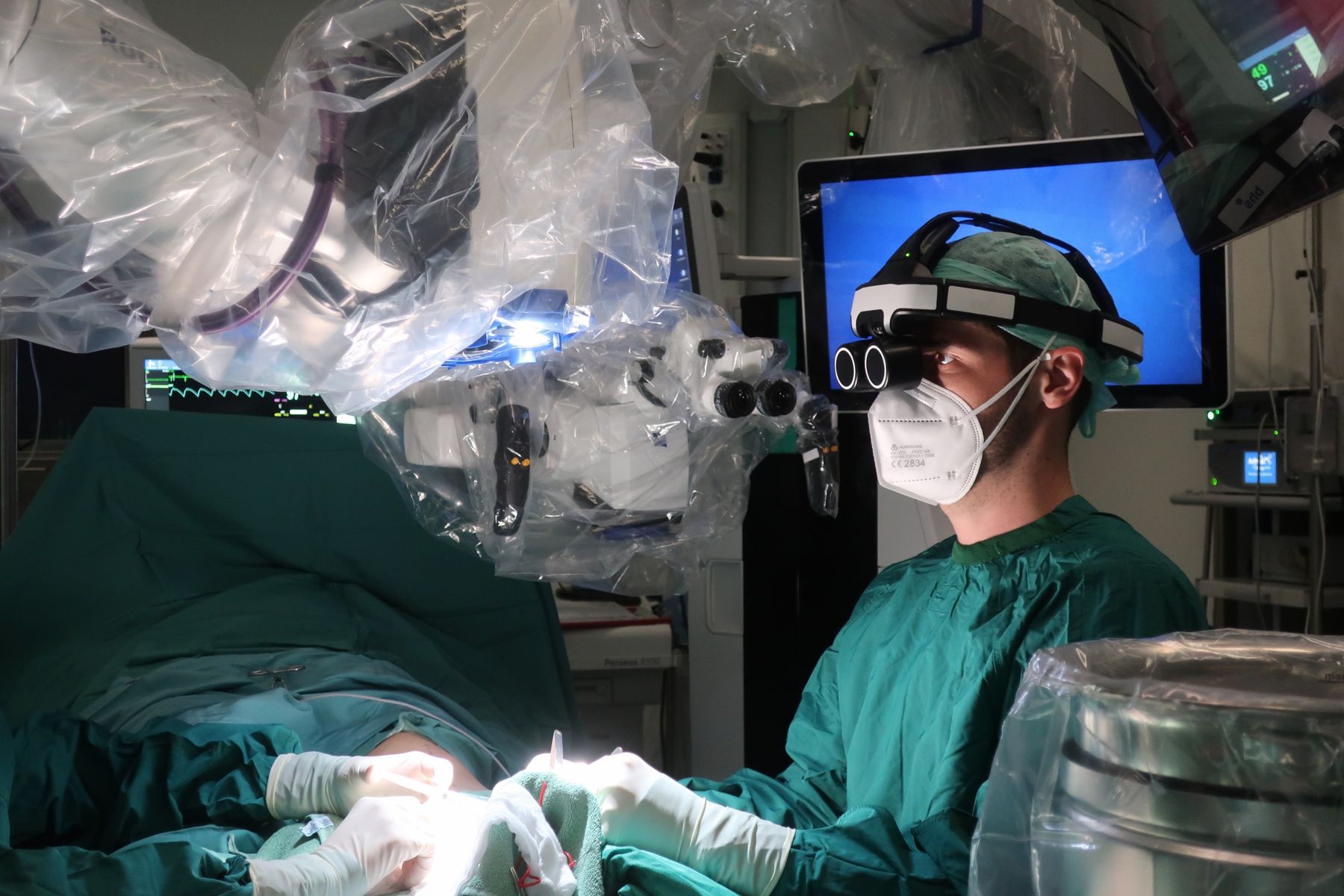
Supermicrosurgical reconstruction · minimally invasive
Through 2–3 cm incisions, lymph vessels smaller than one millimeter are connected to nearby venules under the microscope. The connections are made before the point of obstruction, so lymph can bypass it and drain into the venous system.
Suitable vessels are mapped beforehand with ICG lymphography and high-resolution ultrasound. LVA is most effective in early lymphedema but can also help in more advanced cases.
Local anesthesia with sedation, or general 1 night in hospital Back to desk work in 2–3 weeks
Microsurgical reconstruction · selected cases
Works on the same principle as LVA, but a functioning lymph node is connected to a vein to redirect lymph away from the swollen area. It is useful only in specific anatomical situations.
Physiological reconstruction
Healthy lymph nodes with their own blood supply are moved from a donor site, such as the groin, armpit, above the collarbone, the abdomen or below the chin, to the affected limb. The transferred tissue is thought to stimulate new lymph vessels and to act like a pump that moves lymph into the veins.
Placed in the armpit or groin it supports new drainage pathways; placed at the wrist or ankle it helps drain lymph directly in more advanced disease. The effect develops over several months.
General anesthesia
Reductive surgery
In long-standing lymphedema the limb fills with fat and fibrotic tissue that drainage alone cannot remove. Lymph-sparing liposuction removes this tissue and reduces volume. It differs from cosmetic liposuction and does not restore lymph flow, so compression continues afterwards.
It is usually performed after reconstructive surgery, as a second or third step, once the fluid component is under control.
General anesthesia 2–3 hours 1 night in hospital Compression garment for 6 weeks, then ongoing
Recovery
Typical timelines. Your own plan depends on the procedure, the limb treated and your work.
Operation
Several hours, depending on the number of connections
Anesthesia
Local with sedation, or general
Hospital stay
1 night, 1 day of bed rest
Compression
Bandage for 3 weeks, then garment
Shower
After 2 weeks
Driving
After 1 week
Desk work
After 2–3 weeks
Sport
After 4 weeks
Final result
9–12 months
Operation
2–3 hours
Anesthesia
General
Hospital stay
1 night, 1 day of bed rest
Compression
Garment for 6 weeks, then long-term
Shower
After 1 week
Driving
After 1 week
Desk work
After 1–2 weeks
Sport
After 4–6 weeks
Final result
9–12 months
After surgery, complete decongestive therapy continues with your local therapist. Limb circumference often drops noticeably in the first 1–3 months, so compression garments usually need to be refitted.
Is it right for you?
Each indication is a professional decision based on your records, imaging and examination.
Questions
There is no single best operation. Lymphovenous anastomosis (LVA) is usually the first choice in early lymphedema when functioning lymph vessels remain. Vascularized lymph node transfer is considered when vessels are badly damaged, and liposuction when the limb is filled with fat and fibrotic tissue. Many patients have a staged combination.
No. Lymphedema is a chronic condition. Surgery can reduce swelling, heaviness and the number of skin infections, and some patients need less compression afterwards, but therapy and compression usually continue.
Surgery is considered after at least 6 months of well-conducted complete decongestive therapy, or when conservative treatment no longer brings improvement. Reconstructive surgery works best in early stages, so it should not be delayed once indicated.
Most patients stay one night in hospital, wear a compression bandage for 3 weeks, drive after about a week and return to desk work after 2–3 weeks. Sport is possible after 4 weeks. The final result develops over 9–12 months.
Discomfort after LVA is usually mild. After liposuction it is mild to moderate and is controlled with standard pain relief.
Yes. Compression and decongestive therapy continue after surgery and are essential for a lasting result, especially after liposuction. Garments are usually refitted as the limb gets smaller.
The cost is set individually because it depends on the procedures, the number of stages and the length of stay. You receive a written estimate after the online consultation.
Yes. You start from home with a short enquiry and an online consultation. You travel to Veszprém only for the in-person assessment, the final treatment plan and surgery, and your aftercare continues with your local therapist, with remote follow-up from our team.
Start with a short enquiry. Our reply tells you how to share your records securely, Dr. Mohos then reviews your case in an online consultation, and you receive a written professional recommendation with an estimated cost.